

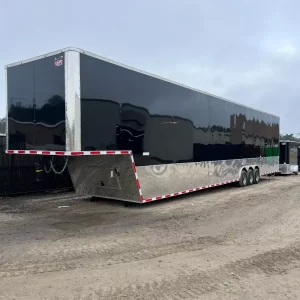
Finding the right gooseneck trailers for sale can make a major difference for contractors, farmers, equipment operators, livestock owners, and businesses that regularly transport heavy loads. A properly selected trailer provides the deck space, load capacity, and hauling configuration your work requires while helping you plan transport more efficiently.
Unlike conventional bumper-pull trailers, gooseneck trailers connect to a hitch installed in the bed of a pickup truck. This arrangement places the hitch point over or near the tow vehicle’s rear axle, which can improve towing stability when the truck, hitch, trailer, and cargo are properly matched. Gooseneck trailers are commonly available as equipment trailers, deckovers, dump trailers, livestock trailers, and other specialized configurations.
At Crystal Trailers, buyers can explore different trailer categories and configurations to find an option that fits their hauling requirements. Whether you need to move construction machinery, agricultural equipment, building materials, or commercial loads, choosing the correct trailer starts with understanding the cargo, the tow vehicle, and the conditions in which the trailer will be used.
When comparing gooseneck trailers for sale, look beyond the advertised price. Deck dimensions, gross vehicle weight rating (GVWR), payload capacity, axle ratings, brakes, ramps, tires, and hitch compatibility all deserve attention. The right trailer is not necessarily the largest or most expensive; it is the one whose specifications match your actual work.
This guide explains nine important buying considerations, compares common gooseneck trailer types, and shows you how to evaluate products before making a purchase.
Table of Contents
Why Buyers Choose Gooseneck Trailers
Many buyers searching for gooseneck trailers for sale need more than a basic utility trailer. They may regularly haul machinery, transport materials between job sites, move agricultural equipment, or handle loads that require a longer and stronger trailer configuration.
A gooseneck setup can be a practical option when the tow vehicle and trailer are designed to work together.
Improved Hitch Position
A gooseneck coupler connects to a compatible hitch installed in the bed of a pickup truck rather than to a conventional rear-mounted receiver. The hitch position can contribute to stable handling when the combination is properly matched and loaded.
However, a gooseneck hitch does not automatically make every truck capable of towing every trailer. The truck’s rated towing capacity, payload, rear axle rating, hitch rating, and other limits must all be considered.
Suitable for Equipment and Commercial Loads
Gooseneck trailers are available in configurations designed for hauling equipment, machinery, materials, and other substantial loads. Depending on the model, features may include wide decks, ramps, beavertails, multiple axles, electric brakes, and heavy-duty couplers.
These features can be useful for contractors, agricultural businesses, and equipment operators who need a trailer designed for repeated use.
Flexible Trailer Configurations
Another reason buyers explore gooseneck trailers for sale is the variety of trailer types available. A deckover equipment trailer has different advantages from a gooseneck dump trailer or a specialized livestock trailer.
Choosing a type according to your cargo helps you avoid paying for features you will rarely use.
For an overview of available options, start with the Crystal Trailers gooseneck trailer inventory. You can compare listings and then review the specifications of individual products.
Understand the Different Gooseneck Trailer Types
Before buying, identify the type of trailer that matches your daily work. A trailer designed for machinery may not be the most convenient option for loose materials or livestock.
Gooseneck Equipment Trailers
Gooseneck equipment trailers are designed for transporting compatible machinery, tools, vehicles, and other equipment. Many feature a flat deck, tie-down points, ramps, or a beavertail to help with loading.
Contractors may use them for suitable skid steers, compact equipment, small machinery, and attachments. Agricultural users may need them for transporting implements and equipment between properties.
The important considerations are the load dimensions, actual loaded weight, ramp capacity, deck height, and tie-down arrangement.
Explore the equipment trailer inventory to compare configurations that may suit your hauling needs.
Gooseneck Deckover Trailers
A deckover trailer has a deck that extends over the wheels, creating a broad usable platform. This layout can be advantageous when the cargo requires substantial deck width or when loading arrangements benefit from a relatively unobstructed platform.
Deckover trailers can be useful for suitable construction equipment, building materials, machinery, and other loads that fit their specifications.
For example, Crystal Trailers lists a Big Tex 8.5 x 25 Gooseneck Deckover Equipment Trailer. Its product listing describes features such as mega ramps, electric brakes, a wood deck, and an adjustable gooseneck coupler. Check the live listing for its current specifications and availability before choosing it for a particular load.
Heavy-Duty Gooseneck Equipment Trailers
Some equipment trailers are built for demanding hauling requirements and come with features such as heavy-duty axles, ramp systems, reinforced structures, and higher ratings.
The trailer still must be selected according to the actual weight of the cargo and the limits of the towing vehicle. A heavy-duty trailer cannot compensate for an undersized truck or an incompatible hitch.
You can review the Big Tex 8.5 x 25 Heavy Duty Gooseneck Equipment Trailer as one example of the equipment trailer configurations listed by Crystal Trailers.
Gooseneck Dump Trailers
A gooseneck dump trailer is designed to carry suitable bulk materials and unload them using its dumping mechanism. Depending on the configuration, these trailers may be used for landscaping materials, construction debris, aggregate, and similar cargo.
When evaluating a dump trailer, check the bed dimensions, side height, hydraulic system, payload rating, gate style, and compatibility with the truck.
Crystal Trailers lists a Big Tex 7 x 16 Gooseneck Dump Trailer. Review its published features and confirm that the specific model fits your material type, operating needs, and vehicle ratings.
9 Things to Check Before Buying
When reviewing gooseneck trailers for sale, use these nine considerations to compare products more effectively.
1. Confirm the Cargo You Will Haul
Begin with the heaviest and largest items you expect to transport. Consider not only their weight but also their length, width, height, wheelbase, ground clearance, and loading method.
A compact piece of machinery may fit easily on one trailer but require a longer deck or different ramp configuration on another.
Account for attachments, accessories, pallets, tools, and other items that will travel with the main load. The total weight matters more than the weight of the main machine by itself.
2. Understand GVWR and Payload Capacity
GVWR stands for gross vehicle weight rating. It is the maximum rated total weight of the loaded trailer, including the trailer itself and its cargo.
Payload capacity refers to the amount of cargo the trailer is designed to carry within its applicable ratings. The published figures should be checked on the specific unit rather than estimated from trailer length or appearance.
For example, a trailer with a larger GVWR may also have a greater empty weight, so it is important to verify its actual payload capacity.
Do not exceed the trailer’s ratings, the truck’s ratings, or any applicable limits for the hitch, tires, axles, and other components.
3. Match the Trailer to Your Tow Vehicle
Not every pickup truck can safely tow every gooseneck trailer. Check the manufacturer’s ratings for the truck’s towing capacity, payload, rear axle, tires, and installed hitch.
The loaded trailer weight and the weight carried by the truck’s hitch must remain within the applicable ratings. Passengers, fuel, tools, and other cargo in the truck also contribute to its total load.
If you are unsure whether a truck and trailer are compatible, consult the vehicle manufacturer and a qualified towing professional before purchasing.
4. Choose the Right Deck Length and Width
Deck dimensions determine how your cargo fits and how easily it can be positioned and secured.
A longer deck may be beneficial for machinery with attachments or for transporting multiple compatible pieces of equipment. A wider deck may provide more room for specific loads, but the width must also be suitable for the intended roads, vehicle, and legal requirements.
Measure your cargo and compare it with the usable deck dimensions. Consider the position of the wheels, fenders, tie-down locations, ramps, and other features that could affect loading.
5. Review Ramps and Loading Features
Ramps make it possible to move suitable equipment onto a trailer, but the ramp system must match the intended cargo and loading method.
Compare ramp length, width, construction, capacity, attachment points, and the manufacturer’s instructions. Check whether the trailer has a beavertail, spring-assisted ramps, removable ramps, or another configuration that suits your equipment.
Do not assume that all ramps are rated for every machine that can physically fit on them.
6. Check Axles, Tires, and Brakes
Axle ratings, tire capacity, wheel condition, suspension, and braking equipment are essential parts of the trailer’s overall load system.
Review the specifications of each component and confirm that the trailer is configured appropriately for the expected load. Make sure the braking arrangement is compatible with the tow vehicle and that required safety equipment is present and serviceable.
For a used trailer, inspect maintenance history and any signs of unusual tire wear, damage, corrosion, or previous repairs.
7. Examine the Coupler and Hitch Compatibility
The gooseneck coupler must match the hitch installed in the truck bed. Check the coupler’s specification, hitch rating, adjustment range, and any relevant installation requirements.
Also consider how the trailer’s height and the truck’s bed configuration affect clearance. The combination should be set up according to the relevant manufacturer instructions.
If the hitch system needs installation or modification, have the work completed by a qualified professional.
8. Evaluate Tie-Down Points and Load Security
Tie-down points and related hardware should be appropriate for the type of cargo being transported. Machinery, vehicles, and building materials may need different securement arrangements.
Inspect the number, placement, condition, and rated capacity of the attachment points. The cargo, trailer, and securement equipment must work together as a system.
The Federal Motor Carrier Safety Administration’s cargo securement guidance explains federal requirements that apply to covered commercial motor vehicles operating in interstate commerce. Check the regulations that apply to your own operation and cargo.
9. Compare the Full Purchase and Delivery Cost
The advertised trailer price is only one part of the buying decision. Depending on your order, the total may also include delivery, applicable taxes, optional accessories, hitch installation, registration, and other preparation costs.
Ask for a written quote showing the trailer price, shipping or delivery arrangements, and any additional charges. Confirm whether custom options are included or quoted separately.
Use the same checklist to compare each unit so you can identify the best fit based on specifications, equipment, condition, and total cost.
How to Choose the Right Trailer Size
The best option among gooseneck trailers for sale depends on how much usable deck space you need and the weight of the cargo you expect to transport.
A longer trailer can offer more flexibility for large machinery, but it may also require more room for turning, parking, backing, and storage. A shorter trailer may be easier to manage for certain applications but lack the deck length required for longer loads.
| Intended application | Features to compare |
|---|---|
| Compact machinery | Deck length, ramp capacity, tie-down locations |
| Construction equipment | Payload, deck dimensions, axle ratings, ramps |
| Long equipment or materials | Usable deck length, overall dimensions, securement points |
| Bulk landscaping or construction materials | Dump body, hydraulic system, GVWR, gate configuration |
| Repeated commercial hauling | Serviceability, brakes, tires, construction, maintenance support |
This table is a starting point. Always verify the manufacturer’s ratings and the full dimensions of your intended cargo.
Measure Before You Buy
Measure your largest expected load and account for attachments or other items that occupy deck space. Check where the load’s weight will be concentrated and whether the trailer’s design accommodates it.
You should also think about future needs. If your equipment fleet is likely to change, a different deck layout or loading system may provide more flexibility. However, do not buy a substantially larger trailer unless your truck, budget, and actual hauling requirements justify it.
What Affects Gooseneck Trailer Prices?
The price of gooseneck trailers for sale can vary considerably depending on their type, size, load rating, construction, accessories, condition, and availability.
Trailer Size and Weight Rating
A trailer’s dimensions and intended load category influence the materials, axles, suspension, brakes, and other components it may require.
A larger or higher-rated model may cost more, but price alone does not prove it is suitable for your cargo. Confirm the specifications and compare the features that matter for your operation.
Equipment and Accessories
Features such as mega ramps, ladder ramps, toolboxes, beavertails, additional tie-down points, spare tires, and specialized deck configurations may affect the total price.
Consider which features are essential and which are optional. Paying for the correct ramp and deck arrangement can be more useful than purchasing extras that do not support your day-to-day work.
New, Used, or Pre-Owned Condition
A new trailer generally has a different purchase profile from a pre-owned unit. With used equipment, condition, maintenance history, previous use, and any warranty or return terms become especially important.
For instance, Crystal Trailers lists a 2021 Quality 8.5 x 24 Gooseneck Equipment Trailer. Its product page identifies it as pre-owned, so buyers should review the listing and confirm its current condition and applicable terms before making a decision.
Shipping and Delivery
Delivery costs depend on the destination, trailer dimensions, logistics arrangements, and any special delivery requirements.
Before ordering, ask whether delivery is included and when the final transportation cost will be confirmed. If the trailer requires custom arrangements, request written confirmation of the delivery plan and associated charges.
Long-Term Ownership Costs
The purchase price is not the only expense to consider. Tires, brakes, bearings, lights, maintenance, registration, and repairs may contribute to ownership costs over time.
A practical buying decision considers the total anticipated cost of ownership alongside the trailer’s suitability for your work.
Explore Gooseneck Trailers at Crystal Trailers
Crystal Trailers provides a range of trailer categories for different hauling needs. Start with the gooseneck trailer inventory to explore the models currently listed.
You may also compare the broader equipment trailer selection when evaluating deck length, loading features, and other configurations.
Examples from the website include:
- Big Tex 8.5 x 25 Gooseneck Deckover Equipment Trailer: A deckover equipment trailer listing that describes mega ramps and other loading features.
- Big Tex 8.5 x 25 Gooseneck Equipment Trailer – 14GN Mega Ramps: Another equipment-hauling configuration with listed specifications for its ramp system, deck, axles, and coupler.
- Big Tex 8.5 x 25 Heavy Duty Gooseneck Equipment Trailer: A heavy-duty equipment trailer option for buyers comparing higher-rated configurations.
- Big Tex 7 x 16 Gooseneck Dump Trailer: A dump trailer listing for buyers whose work involves suitable loose materials.
These are examples from the website, not a guarantee of current stock. Product specifications, prices, and availability can change, so confirm the live listing and final details before ordering.
You can learn more about the dealership through the Crystal Trailers About Us page or discuss a particular model through the Contact Us page.
Gooseneck vs. Bumper-Pull Trailers
Buyers comparing gooseneck trailers for sale sometimes also consider bumper-pull trailers. The right choice depends on the cargo, the towing vehicle, the frequency of use, and the environment in which the trailer operates.
A bumper-pull trailer normally connects to a receiver hitch near the rear of the tow vehicle. A gooseneck trailer connects to a compatible hitch in the pickup truck bed.
| Factor | Gooseneck trailer | Bumper-pull trailer |
|---|---|---|
| Hitch location | In the truck bed | Rear receiver or bumper-area hitch system |
| Typical applications | Many equipment and heavier commercial hauling applications | A wide range of light and medium-duty applications |
| Truck setup | Requires a compatible gooseneck hitch | Requires a compatible receiver and hitch |
| Turning and clearance | Depends on the truck, trailer, and hitch setup | Depends on the truck, trailer, and hitch setup |
| Selection priorities | Load ratings, bed and hitch compatibility, deck layout | Load ratings, receiver and hitch ratings, trailer layout |
Neither system is automatically the best option for every job. Confirm the tow vehicle’s ratings, trailer ratings, hitch compatibility, local requirements, and intended load before purchasing.
If your workload involves frequent heavy-equipment hauling and your truck is properly equipped, a gooseneck may be appropriate. For lighter loads or a different use case, a bumper-pull trailer may be more suitable.
Towing, Loading, and Maintenance Considerations
Choosing one of the available gooseneck trailers for sale is only the beginning. Proper setup, loading, inspection, and maintenance are essential parts of using a trailer responsibly.
Confirm the Complete Combination
The tow vehicle, hitch, trailer, and cargo must be compatible. Check all applicable ratings rather than relying on a single maximum towing figure.
If the trailer or truck has been modified, confirm how those modifications affect the relevant ratings and installation requirements.
Plan the Load
Arrange cargo according to the trailer manufacturer’s loading instructions and the type of cargo being carried. Avoid exceeding weight limits or placing the load in a way that compromises stability. gooseneck trailers for sale
Use securement devices that are suitable for the cargo and attachment points. The load should be restrained against movement, in accordance with the requirements applicable to your operation. gooseneck trailers for sale
Keep Up With Inspections
Inspect tires, wheels, brakes, lights, hitch components, safety chains, ramps, and the trailer structure regularly. Pay attention to damage, unusual wear, corrosion, or loose components. gooseneck trailers for sale
Follow the maintenance schedule and instructions provided by the manufacturer. Seek qualified service when components require adjustment, replacement, or repair. gooseneck trailers for sale
Crystal Trailers also describes repair and parts support through its website. Confirm directly which service options are available for your model and location. gooseneck trailers for sale
Frequently Asked Questions
What are gooseneck trailers used for?
Gooseneck trailers are used for a range of applications, including equipment transport, machinery hauling, agriculture, construction, and specialized commercial work. The appropriate model depends on the cargo, required deck dimensions, weight ratings, and tow vehicle. gooseneck trailers for sale
Are gooseneck trailers better than bumper-pull trailers?
Not in every situation. Gooseneck trailers connect through a hitch in the truck bed and are often considered for equipment and other demanding hauling applications. Bumper-pull trailers may suit many lighter or different applications. The tow vehicle, hitch, trailer, and load must all be compatible. gooseneck trailers for sale
How do I choose the right gooseneck trailer size?
Start with the weight and dimensions of the cargo you intend to transport. Compare usable deck length and width, payload capacity, ramp features, axle ratings, and loading requirements. Also confirm that your towing vehicle can handle the intended combination. gooseneck trailers for sale
What does GVWR mean on a gooseneck trailer?
GVWR is the gross vehicle weight rating: the maximum rated total weight of the trailer and its contents. Check the rating plate and product specifications for the actual trailer. Do not confuse GVWR with payload capacity.
Can any pickup truck tow a gooseneck trailer?
No. The truck needs a compatible hitch and sufficient capacity for the specific trailer and its load. Check the vehicle’s towing capacity, payload, rear axle rating, hitch rating, and other requirements before purchasing.
What should I compare when shopping for gooseneck trailers for sale?
Compare the trailer type, deck dimensions, load ratings, axles, tires, brakes, hitch compatibility, ramp system, tie-down points, condition, warranty terms, and total purchase and delivery cost. gooseneck trailers for sale
Are used gooseneck trailers worth considering?
A pre-owned trailer may suit a buyer looking for a different price point, provided its condition, ratings, and specifications match the intended work. Review maintenance history and inspection details, and clarify warranty and return terms before purchasing. gooseneck trailers for sale
Does the listed trailer price include delivery?
That depends on the individual listing and the delivery arrangements. Check whether shipping is included, how the final transportation cost is calculated, and whether additional charges apply to your destination. gooseneck trailers for sale
Where can I find gooseneck trailers for sale?
You can start by browsing the Crystal Trailers gooseneck trailer inventory. Review individual product pages, confirm availability, and contact the dealership to discuss the specifications and delivery details for your chosen model.
Find Your Gooseneck Trailer
Choosing among the available gooseneck trailers for sale begins with a clear understanding of the cargo you need to transport and the vehicle that will tow it. Trailer length, deck layout, GVWR, payload, ramps, hitch compatibility, and delivery arrangements all contribute to a good purchase decision. gooseneck trailers for sale
For contractors, farmers, and equipment operators, the right configuration can help support regular hauling requirements and make loading and transport planning more manageable. The goal is not simply to purchase a trailer with the largest ratings; it is to find a model whose specifications match your actual workload.
Start by comparing the gooseneck trailer inventory, then review product pages for specific configurations such as the Big Tex deckover equipment trailer. Confirm product details, availability, and delivery arrangements before placing an order. gooseneck trailers for sale
Ready to find the right trailer for your work? Visit Crystal Trailers to explore available options or contact the team to discuss your hauling requirements. gooseneck trailers for sale